
If Monday already feels like Friday, and your to-do list keeps growing no matter how late you stay, you may be caught in the burnout cycle. This guide breaks down the real effects of the burnout cycle on full-time employees and the managers who lead them, and lays out specific, practical steps that help you step out of the cycle before it becomes your normal.

What Is the Burnout Cycle, and Why Does It Keep Repeating?
The burnout cycle is the repeating pattern of overload, exhaustion, partial recovery and relapse that traps full-time employees who never address the root cause of their stress. It is not one bad week. Workload builds, energy drops, a short break brings temporary relief, and the same pressures return before real recovery has happened.
The World Health Organization classifies burnout as an occupational phenomenon rather than a medical diagnosis, describing it as a syndrome resulting from chronic workplace stress that has not been successfully managed, marked by exhaustion, growing mental distance from the job, and reduced professional efficacy. That framing matters. It positions burnout as a workplace pattern, not a personal failing, which is the first step toward breaking the cycle instead of blaming yourself for being in it.
What Are the Effects of the Burnout Cycle on Full-Time Employees?
The effects of the burnout cycle on full-time employees show up across four areas: physical health, day to day performance, relationships at work, and long-term career decisions. Left unaddressed, each area tends to reinforce the others, which is exactly how a temporary rough patch turns into a genuine cycle.
1. Energy and health
Fatigue is usually the first sign. Sleep gets lighter, you feel drained by midweek, and sick days become more frequent. Gallup’s research found that employees who frequently feel burned out are 63% more likely to take a sick day. Exhaustion is also the first of the three features the WHO uses to define burnout.
2. Work performance
As mental bandwidth narrows, quality slips in small ways first. Deadlines drift, small errors creep in, and decisions that used to be quick take longer. The WHO calls this reduced professional efficacy: you are putting in the effort, but it no longer produces the same results.
3. Team and relationships
Burnout rarely stays private. Patience with colleagues wears thin, mentoring is often the first thing to go, and you pull back from team conversations. The WHO’s definition includes growing mental distance from the job, and colleagues often notice that distance before you do.
4. Career trajectory
Over time, ambition flattens. Work you once found satisfying starts to feel like a chore, disengagement sets in quietly, and leaving begins to look like relief. Gallup found that employees who frequently feel burned out are 2.6 times as likely to be actively seeking a different job. That is why breaking the cycle early matters for the person and for the team.
Why Does Burnout Culture Make Stressed Managers Feel More Overwhelmed?
Burnout culture is a workplace norm that treats constant overwork as a badge of commitment rather than a warning sign, and it hits managers from both directions at once. They absorb pressure from above and shield their teams from it below, which is exactly why so many managers describe themselves as stressed managers even while their own workload keeps expanding.
This pattern shows up in the data. Gallup’s workplace research has repeatedly found that managers report more stress and worse work-life balance than the people they manage. Common drivers include:
- An unsustainable work load with no corresponding adjustment to headcount or timelines
- Unclear expectations from senior leadership, which forces managers to guess at priorities
- Always-on communication norms that erase the line between work hours and personal time
- Recognition that rewards output rather than sustainable pace, reinforcing burnout culture from the top down

How Do You Know You Are Running Yourself Ragged Instead of Just Busy?
Being busy has a natural rhythm: intense stretches are followed by recovery. Running yourself ragged has no recovery built in. If the following signs feel familiar most weeks rather than occasionally, you are likely deeper into the burnout cycle than a normal busy season.
- You regularly skip meals or eat at your desk without noticing
- You have cancelled personal plans more than once in the last month because of work
- You feel resentful about tasks you used to find satisfying
- You are constantly tired even after a full night of sleep
- You cannot recall the last time you felt fully off from work
How to Avoid Being Overwhelmed: Practical Steps to Break the Burnout Cycle
Learning how to avoid being overwhelmed is less about one dramatic change and more about a small set of consistent habits that interrupt the cycle before it repeats. The following five steps are a practical starting point, not a complete overhaul.
- Name the pattern. Write down, in one sentence, what your personal burnout cycle looks like. Naming it makes it visible and easier to interrupt.
- Protect one recovery window daily. Set aside a short block, even 20 uninterrupted minutes, away from screens. It will not fix a heavy work load on its own, but it gives you a regular pause before the pressure builds again.
- Renegotiate the work load directly. Bring one specific, time-bound ask to your manager rather than a general complaint about being overwhelmed.
- Rebuild confidence in leadership through small wins. Choosing and completing one manageable priority each day restores a sense of control that burnout erodes first.
- Build your support system before you need it. Identify one peer, mentor or resource you can turn to, so you are not starting that search in the middle of a crisis.
These steps sit alongside the broader self-leadership approach I write about across my site: sustainable performance starts with how a leader manages themselves, not only how they manage their team.
When Should You Ask for Support Instead of Pushing Through?
If you have tried the steps above for several weeks, and the effects of the burnout cycle on full-time employees described earlier are still present, that is a signal to bring in outside perspective rather than push through alone. Support does not have to mean a major intervention. Often it starts with a single conversation, a structured resource, or hearing how someone else navigated the same overwhelm.

A Free Next Step
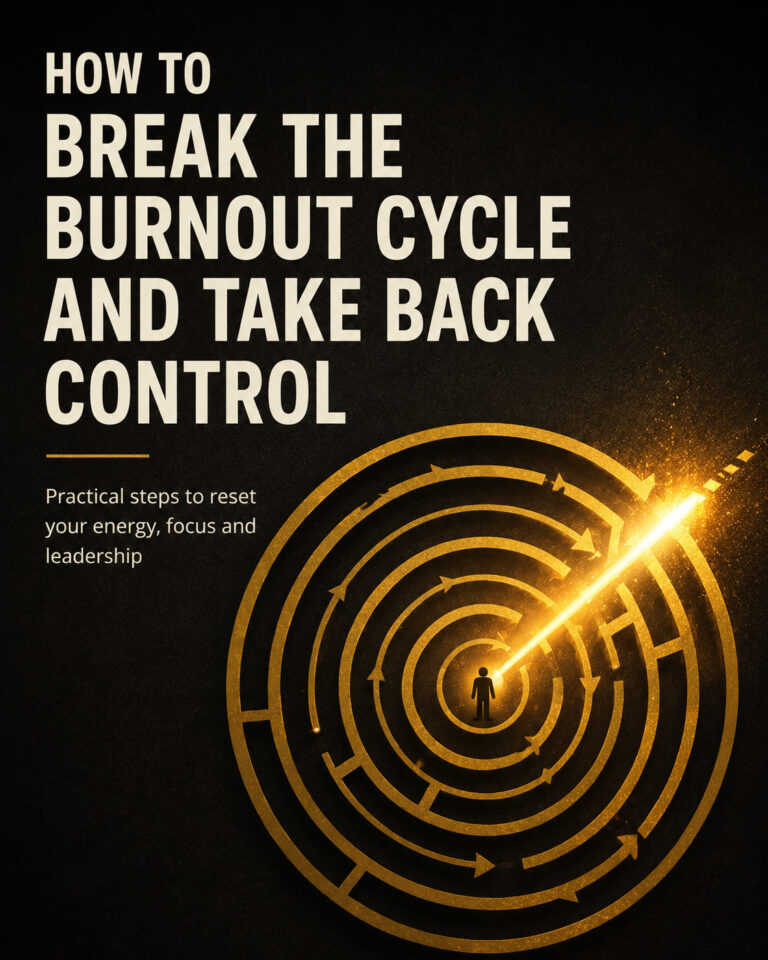
If any of this sounds familiar, you do not have to figure out your next step alone. My free guide, How to Break the Burnout Cycle and Take Back Control, walks through a practical framework for regaining energy and confidence in leadership without waiting for burnout culture to change around you first. It takes only a few minutes to download, and it gives you a concrete starting point for the week ahead.
My book, The Discipline of Time, complements these ideas with practical guidance to help you protect your focus, manage your workload, reduce distractions, and use your time more intentionally before overwhelm develops into burnout.

If you are serious about building discipline, taking control of your time and lifting the quality of your life, join me across my platforms.
🌍 Website: terryshadwell.com
🎥 YouTube: youtube.com/@TerryShadwell-dd9dx
💼 LinkedIn: linkedin.com/in/terry-shadwell-2618a773
📷 Instagram: instagram.com/terryashadwell
✖️ X: x.com/shadwell_t
Terry Shadwell
Start Your Next Level
If you are navigating workplace pressures, business demands, and the responsibility of managing people and priorities, strengthening your personal leadership, developing genuine self awareness, and learning how to take accountability can help you make progress towards your personal growth goals.
Explore the Invigorating Business Solutions and Terry Shadwell Leadership collection of best self development books, created to help you take control, build confidence in leadership, and move forward.